
Analogue Warmth with Sonimus Plugins
Saturation is a big part of records. It’s what turns aseptic digital audio recordings into rich and characterful sounds. It can make instruments pop up in the mix, and when taken to the extreme, create distorted versions that sound aggressive. We talked about saturation on the blog previously, and we learned that it’s all about adding harmonics to the sound.
Every piece of analogue equipment leaves a mark on the sound that passes through it in the form of saturation. While many engineers try to design the cleanest equipment possible, others create equipment that adds life and personality to the signal. Sometimes even unintentionally. But it is the sound of analogue equipment that lives and breathes through countless records and has forged into our brains how things should sound.
Whether you’re working in rock, pop, electronic, or hip-hop, integrating analogue-style saturation into your mixes can add depth, cohesion, and presence — helping your tracks feel more “alive.” Below, we explore how Sonimus plugins emulate analogue saturation across consoles, EQs, and dynamics, and how to apply them effectively in real mixing scenarios.
Console Emulation: The Heart of Analogue Saturation
Analogue consoles contribute more than just summing — they subtly color and glue tracks together through nonlinearities, harmonic distortion, and crosstalk. That’s why having Console Emulation plugins such as N-Console, A-Console, or T-Console can turn a lifeless recording into a more cohesive sound.
Having two saturation modes on all the consoles — Normal (for cleaner sound) and Fat (for more driven harmonic content) — allows for a more subtle effect or greater emphasis on each console’s characteristic sound. In fact, T-Console defaults to FAT mode to bring the real feel of the original tube console.
Satson Channel Strip expands on this by combining saturation, EQ, and compression in a modular environment. Its channel module adds colour similar to an analogue console input, and, using the Gain Compensation feature, increasing the input gain naturally drives the saturation harder, giving instruments like guitars and vocals more body and presence. The modularity of Satson CS allow to reorder modules to tailor your saturation-EQ-compressor chain per track — ideal for sculpting character while maintaining clarity.
How to use in mixing
Start your mix by inserting your favourite console emulation on individual tracks, or on group buses. Use Normal for subtle glue and Fat to add punch or edge on aggressive genres, or to bring elements forward in the mix.
EQ Saturation
Traditional analogue EQs don’t just shape frequency — they often impart sonic colour at higher gains. Sonimus offers a range of EQs that blend precise control with musical saturation:
SonEQ Family
Whether you are using our free plugin SonEQ, SonEQ Pro or SonEQ 2 you get analog-style EQ curves and musical response, perfect for clean tone shaping with subtle warmth.
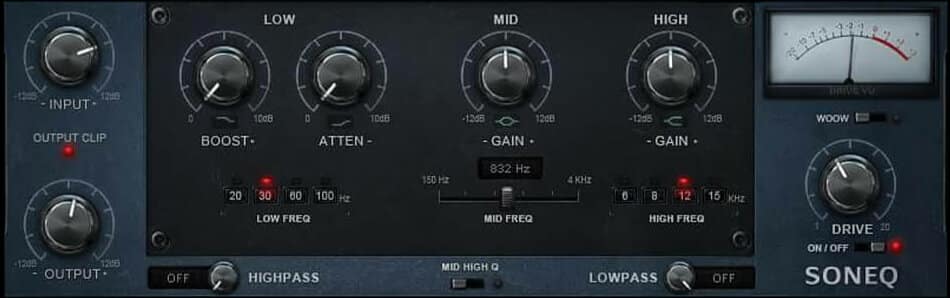
A-EQ / Burnley 73 / StonEQ 4K
A-EQ and classic-inspired EQs like Burnley 73 and StonEQ 4K emulate vintage hardware curves, each with their own saturation character. These are especially effective for midrange enhancement, giving guitars a more focused bite or vocals a warm body without harshness.
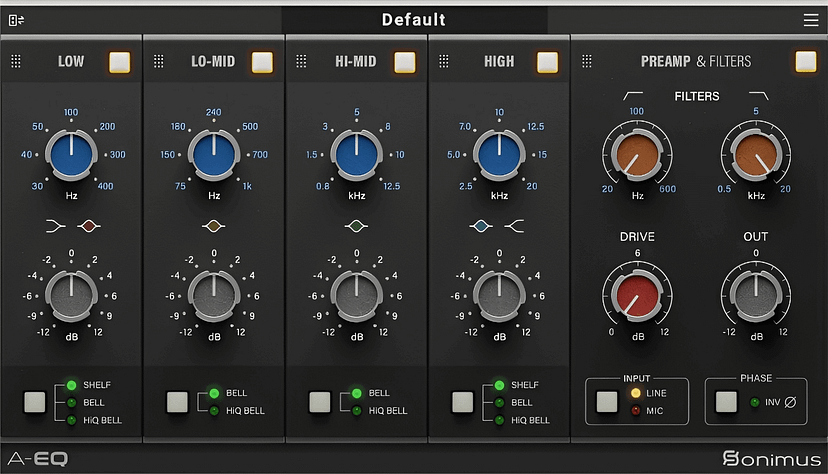
Both A-EQ and SonEQ 2 takes this further with a modular architecture, allowing users to build custom analog-like EQ chains that can introduce harmonics thanks to the preamp module, adding richness to vocals and instruments.
How to use in mixing
Apply these EQs before or after the saturation stages to clean up, shape, or fine-tune the tonal balance while keeping analogue warmth intact. For example, use SonEQ 2 on vocals to gently boost presence and air, or StonEQ 4K on bass to add low-end richness. Don’t be afraid of using the drive knob to let the EQ’s character emerge naturally.
Compressors with Character
Applying compression to a signal changes its envelope. This distortion creates new harmonics that effectively changes the tone of the sound. That’s why compression is more than controlling peaks — it’s about how the compressor’s circuitry interacts with the tone.
TuCo Compressor
Based on vari-mu tube technology, TuCo delivers smooth, warm compression with crisp character. The inherent saturation from its tube emulation can thicken tracks and add harmonic depth, making it ideal on drums, vocals, or a mix bus.
How to use in mixing
Use TuCo on group buses for gentle “glue” compression that complements console saturation. On individual tracks, let the compressor’s analogue-style drive interact with the source dynamics to smooth peaks without losing energy.
Practical Workflow on a Modern Mix
Here’s how you might combine these tools on a modern pop mix:
- Start with Console Saturation by inserting Satson on your drum bus and T-Console on synth groups to add analogue warmth and a cohesive feel across elements.
- Then use Burnley 73 on vocals and guitars to enhance body and clarity, and use subtle saturation with the drive knob to enrich the sound.
- Add TuCo Compressor to your drum and mix buses to control dynamics while imparting tube-like harmonic richness. ([Sonimus][1])
- Finally, consider using SonEQ or SonEQ2 to gently sculpt the full mix and reinforce the analogue vibe.
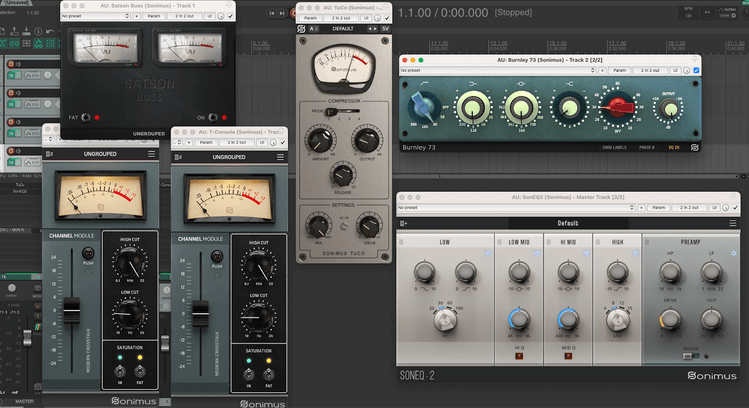
Sonimus plugins offer a powerful bridge between analogue character and modern digital workflows. Whether you’re chasing subtle saturation or rich harmonic tone, our console emulations, EQs, and compressors give you the tools to inject life into your mixes without losing clarity.
Get the sound of great real analogue equipment straight into your DAW without compromise.
Comment below and subscribe to our newsletter to know about more creative ways to use Sonimus plugins.









Leave A Comment
You must be logged in to post a comment.